Runs, cost and retention
Three views of the dashboard: every supervised run, what they cost, and how long any of it is kept.
Runs
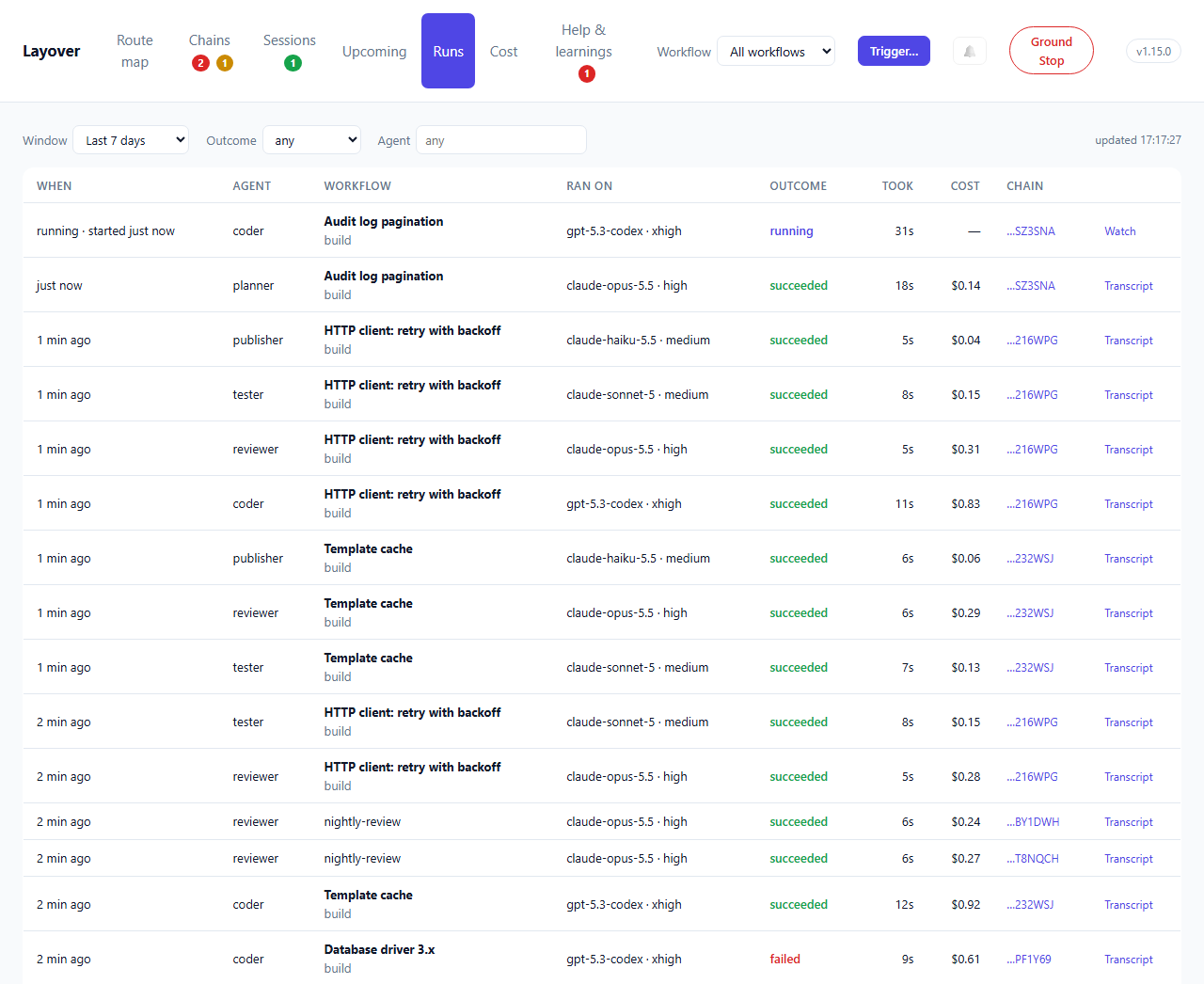
Every supervised execution, newest first, filterable by window, outcome and agent, a hundred at a
time with Show 100 more below. A running run says running · started 4 min ago rather than
when it finished. Each says which chain it belongs to — the end of its identifier, where
identifiers differ, with the chain's name in the tooltip — and clicking that opens the chain.
Ran on is the model and effort the run's command line gave it; hover it for the context too.
Each run keeps the model, effort and context its command line gave it, so history answers
"which effort did that run use?" without opening a transcript; a session's header shows them, and
GET /runs returns them as model, reasoning_effort and context. Runs recorded before Layover
kept effort and context have neither.
| Outcome | Means |
|---|---|
running | Still going |
succeeded | Exited cleanly |
failed | Exited non-zero |
timed_out | Hit timeout_sec and was killed |
halted | A rail refused it: Hops, Fuel, the run cap or the Reserve |
interrupted | Alive when the Tower went away — see Recovery |
A failure that was not the run's own says whose it was. A run the model service ended — its last
call rejected or never answered, and nothing after it — is failed · model service, never
succeeded; GET /runs gives it cause: provider_error and the provider's request_id, and its
detail says what the service said and whether it is being
restarted:
exited with code 1: the model service failed (http_400): Execution failed: 400 internal server
error (Request ID: 00000-7a12…); restarting as attempt 2 after a 1-minute wait
halted is deliberately not coloured like a crash. A rail stopping work is the system doing its
job, and colouring it red teaches people to ignore red.
A run that exited on its own carries its exit code. A failed one also carries a one-line
detail: how the process exited and the line of its output most likely to be the reason —
the last line that says error or failed, or failing that the last thing it printed:
exited with code 1: Error: Failed to read MCP config file "…\mcp.json": The system cannot find
the path specified.
The line is picked, not summarised — Layover calls no model — and it is redacted and capped at 300 characters before it is written, because a transcript is where a CLI that failed to authenticate prints what it tried. The whole transcript stays in the run's Hangar. Hover a row to read the detail.
A run whose cost the runner never reported shows not reported, never $0.00. The two are
different facts, and the difference decides whether the budget rail is working.
Cost
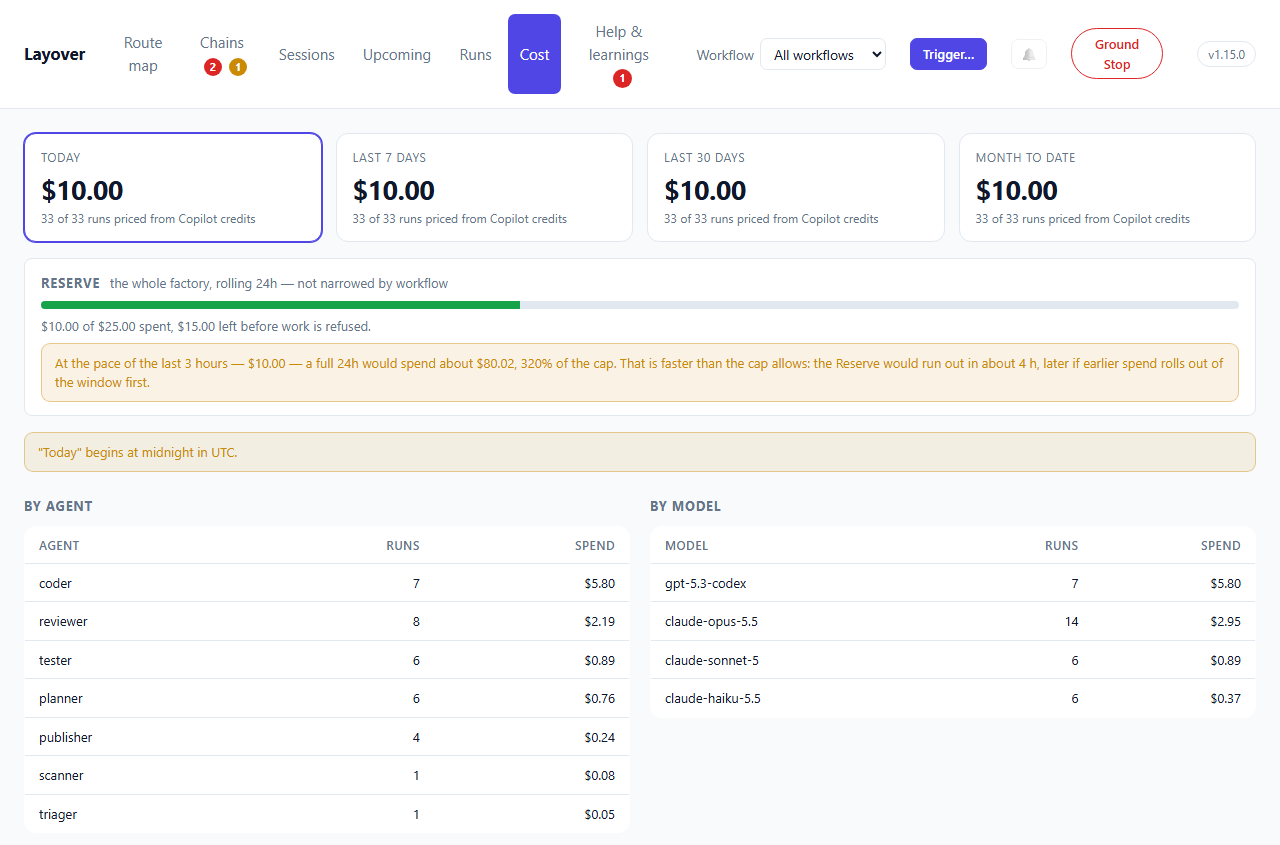
Seven windows, of two kinds, and the distinction is part of the answer rather than a detail.
| Window | Kind |
|---|---|
| Today, Month to date | Calendar — begins at local midnight |
| Last 24 hours, 7 days, 30 days, 90 days | Rolling — a fixed number of hours ending now |
| All time | Everything still kept |
A rolling window is the same length everywhere on earth. A calendar window is not: "this month" begins at midnight somewhere, and the page names the zone it used. Rolling windows say they used none, and that absence is deliberate — nobody should have to wonder which zone "last 7 days" meant.
Conflating the two is not a theoretical hazard. Gating spend on a UTC day boundary while reporting the ledger in local time lets a factory spend one day's money twice, and the bug is invisible until it matters.
Every total carries its provenance, shown next to the figure rather than tucked away:
- "all measured" — every run's cost was measured: dollars the runner printed.
- "n of m runs priced from Copilot credits" — also measured: Copilot reported the AI credits those
runs used, and they are priced at
[copilot] usd_per_credit. Named so that the arithmetic stays visible. - "n of m runs priced from a rate card" — part of this is an estimate.
- "n of m runs reported nothing" — part of this is a hole, and the total is a lower bound.
A total with a hole in it is never shown as a plain figure. It carries a + — $12.40+ — and one
where every run reported nothing reads not reported rather than $0.00, here, in the
breakdowns and in each workflow's spend, 7d on the route map. A plain $0.00 beside runs that
did work is how a factory whose runner prints no cost comes to look free; layover doctor says
which runner it is and what to add to its command.
The weakest source wins. A figure that is 90% measured is still not measured, and saying so is the
entire point of tracking where a number came from. The page says once, under the cards, what a +
means whenever one is showing.
Click a card to look at that window; its address keeps it, #cost?window=last_7d. Below the
Reserve, for any window longer than a couple of days, Day by day draws a bar per day — the
days nothing ran on included, so a gap reads as a gap — with the peak and the daily average. Days
begin and end at midnight where the Tower is, and the page names the zone. A day with a run that
reported nothing has a dashed top, because its bar is a floor; the first and last days of a rolling
window are partial, and today's bar is lighter for being unfinished.
Beside By workflow, Most expensive chains names the ten pieces of work that cost the most in the window — one level below the agent, so "the reviewer is expensive" becomes "this review of this PR was". Click one to open it.
The Reserve
Below the window cards is the Reserve: the factory's own ceiling, over its own rolling window.
It is drawn apart from those cards because it answers a different question over a different
period and a different scope. The cards say what something cost, over the window you picked,
for the workflow you picked. The Reserve says what may still be spent, over the hours
[reserve] window_hours names, across every workflow at once.
Putting it among figures that narrow would invite reading it as one of them — and a spending rail misread as covering less than it does is worse than one not shown at all. It says on its face that it is not narrowed.
A factory whose [reserve] fuel_usd is 0 has no ceiling, and the meter is hidden rather than
drawn empty. One that writes no [reserve] at all has the default, $100 in any rolling 24 hours.
Under the meter is its pace: the last three hours' spend, as it would be over the Reserve's
whole window — At the pace of the last 3 hours — $36.41 — a full 24h would spend about $291.31, 3% of the cap. A factory spending faster than the cap allows is told roughly when it would run
out. Read from every workflow's runs, as the Reserve is.
The meter is the same figure the Tower checks before every run. When it is full, new runs are
refused and their chains show as halted, with the reason and the time the window frees room — see
Cost.
Retention
History is kept for 90 days, in .layover/history, as one JSON Lines file per UTC day.
Retention is applied when layover serve starts, not on a timer. A process left running for
months therefore keeps more than ninety days until it is next restarted — the horizon is a floor
on what is kept, not a ceiling.
Deleting is therefore deleting whole files — no rewriting, no compaction, and no window where history is half-pruned because the process died in the middle of it. A window reaching further back than 90 days reports a lower bound and says so.
What else the horizon reaches
| Path | Holds | Pruned? |
|---|---|---|
.layover/history/runs-*.jsonl | One record per run | Yes, whole files |
.layover/journal/help-*.jsonl | Help requests | Yes, whole files |
.layover/journal/skips-*.jsonl | Scheduled ticks that were skipped | Yes, whole files |
.layover/hangars/<agent>/run_*/ | A run's prompt and transcript | Yes, whole directories |
.layover/hangars/<agent>/memory.md | What the agent wrote for itself | No |
.layover/journal/learnings.jsonl | Every learning | No — but a lapsed one is deleted after [learnings] keep_lapsed_days |
Hangars are pruned by the age encoded in the run's own identifier rather than by the file's modification time. A run id is a ULID, so it carries the millisecond it was minted; asking the name is exact, where asking the filesystem is a guess that a copy, a restore or a backup tool would get wrong.
A directory in a Hangar that Layover did not mint is left alone, whatever its age — its age is unknown, and deleting on a guess is how somebody's own notes disappear.
memory.md sits beside those run directories and is never pruned, for the same reason learnings
are not: an agent's accumulated knowledge should not get worse for being old.
This gap was found by the 48-hour soak, not by a test. Hangars grew without bound while everything around them was pruned — and after ninety days a factory held transcripts for runs whose records had been deleted, which is evidence attached to nothing.
The files are plain text, one JSON object per line, and are meant to be read:
$ tail -1 .layover/history/runs-2026-09-16.jsonl
{"run":"run_01K...","itinerary":"itn_01K...","agent":"developer","pipeline":"development",
 "outcome":"succeeded","started_at":"2026-09-16T10:00:00Z","finished_at":"2026-09-16T10:04:30Z",
 "usd":1.25,"source":"reported","usage":{"input":18402,"output":3100,...},"exit_code":0,
 "sent_by":["analyst"]}
sent_by names the agents whose flights started the run — every arrival, for a released join — and
is [] for work from outside the mesh. It is absent from records written before it was kept.